Absolutely a story — and a huge one. This is happening right now, right here. Here's the article:
The next time you're stuck on Highway 1 crawling toward Monterey, or grinding down 101 toward Salinas on a Friday afternoon, consider this: a company at Marina Municipal Airport is working on a solution that involves none of those roads at all.
Joby Aviation is building electric flying taxis in Marina, California. They have already flown one from Marina to Monterey Regional Airport. They have already flown one to Salinas Municipal Airport as part of the California International Airshow. And they are on track to begin carrying paying passengers sometime in 2026.
This is not science fiction. It is happening right now, a few miles up the road.
What Is Joby Building?
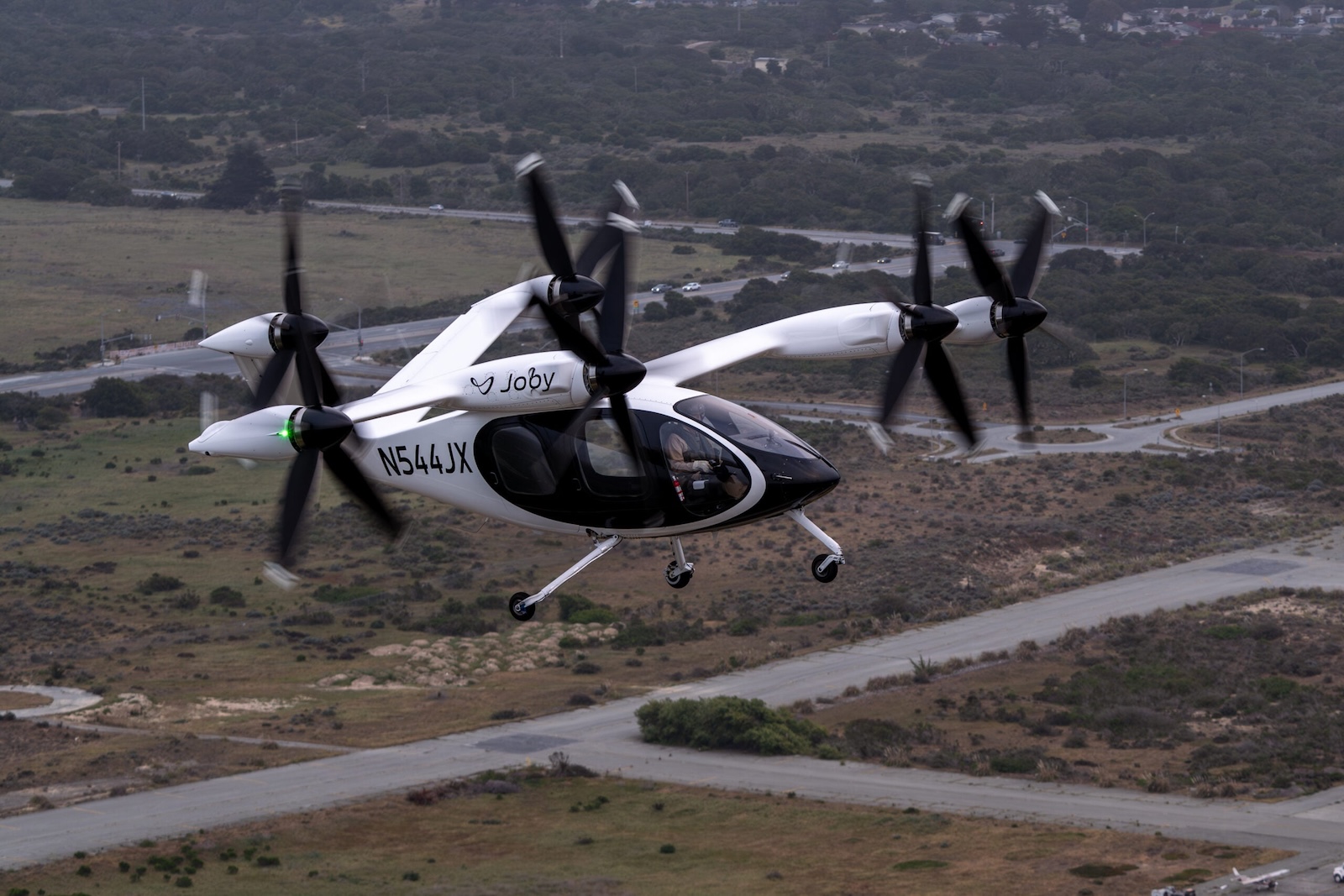
The Joby S4 is an all-electric aircraft that takes off and lands vertically like a helicopter but cruises on fixed wings at around 200 miles per hour — quieter, faster and cleaner than anything currently operating in commercial aviation. Joby Aviation has a manufacturing and testing facility at Marina Municipal Airport where the aircraft are being built and test flown on a regular basis.
In 2025 alone, Joby completed more than 850 flights — a 260 percent increase over 2024 — covering more than 50,000 miles across its fleet. Those flights happened in California, the UAE and Japan, including 41 flights at the World Expo 2025 in Osaka and demonstrations at the Dubai Airshow. But the home base, the place where the aircraft are built and where test pilots put them through their paces day after day, is Marina.
Already Flying Between Our Airports
Here's the part that should make Monterey County residents sit up: Joby completed its first point-to-point flight between Marina Municipal Airport and Monterey Regional Airport in August 2025 — two public airports with active commercial operations. A second flight took place between Marina and Salinas Municipal Airport as part of Joby's participation in the California International Airshow.
Think about what that means. An electric aircraft took off vertically from Marina, flew to Monterey — a trip that takes 20 to 30 minutes by car on a good day — and landed. Then it did the same thing to Salinas. These were not test flights over the ocean. These were point-to-point flights between airports that locals use every day.
The Company Behind It
Joby Aviation was founded in 2009 by JoeBen Bevirt, incubated on his ranch in the Santa Cruz Mountains. What started as a small research project exploring electric motors, flight software and lithium-ion batteries has grown into one of the most heavily funded aviation startups in history, backed by Toyota, Delta Air Lines, Uber and the U.S. Air Force.
In January 2020, Joby announced plans to manufacture the aircraft in Marina, California at Marina Municipal Airport, including building a 55,000 square foot production facility followed by a 500,000 square foot factory. The company chose the Central Coast not by accident — the geography, the airspace and the proximity to Silicon Valley talent made it an ideal home.
Joby is now rapidly scaling its manufacturing footprint, with an expanded production site in Marina, a specialized powertrain facility in San Carlos, and a newly acquired 700,000-square-foot facility in Dayton, Ohio, designed to support plans to increase production to up to four aircraft per month in 2027.
Certified, Backed and Ready to Scale
In March 2026, Joby announced it had begun flight testing its first FAA-conforming aircraft for Type Inspection Authorization — a major step on the path to full type certification. Initial testing by Joby pilots will pave the way for FAA pilots to visit the company's Marina facility to conduct the rigorous testing required to validate the aircraft for commercial passenger service.
The company has also been selected to participate in the White House-backed Electric Vertical Takeoff and Landing Integration Pilot Program, giving Joby the opportunity to begin early operations in Arizona, Florida, Idaho, New Jersey, New York, North Carolina, Oklahoma, Oregon, Texas and Utah in 2026.
California, notably, is not yet on that list — a proposal including Monterey County, the City of Marina and several local agencies was submitted but did not make the initial cut. The proposal had included air taxi demonstrations at large-scale public events in Monterey, Santa Cruz and Santa Clara counties. The effort to bring operations to California continues.
What This Means for Monterey County
The implications are significant. Joby's goal is to turn long commutes into seamless, minutes-long journeys — reclaiming the hours lost to traffic by offering fast, quiet, emissions-free flight between city centers and airports. A trip from Salinas to San Jose that takes an hour and a half by car could become a 20-minute flight. Getting from Marina to Monterey could take less time than finding a parking spot.
The aircraft are also remarkably quiet. Unlike helicopters, which announce themselves from miles away, the S4 is designed to be no louder than ambient background noise at 500 meters — which matters a great deal for communities near flight paths.
The jobs matter too. Joby's Marina facility is already employing engineers, test pilots, mechanics and manufacturing workers from the local community, with hundreds more positions expected as production scales up.
Watch the Skies
If you've been out near Marina Municipal Airport on a clear day and noticed an unusual aircraft — something that doesn't quite look like a plane or a helicopter, rising silently into the air and tilting forward into cruise — that's Joby. They've been there for years, getting this right.
The flying taxi is not coming to Monterey County. It's already here. It just hasn't started selling tickets yet.

Comments (0)
Leave a Comment